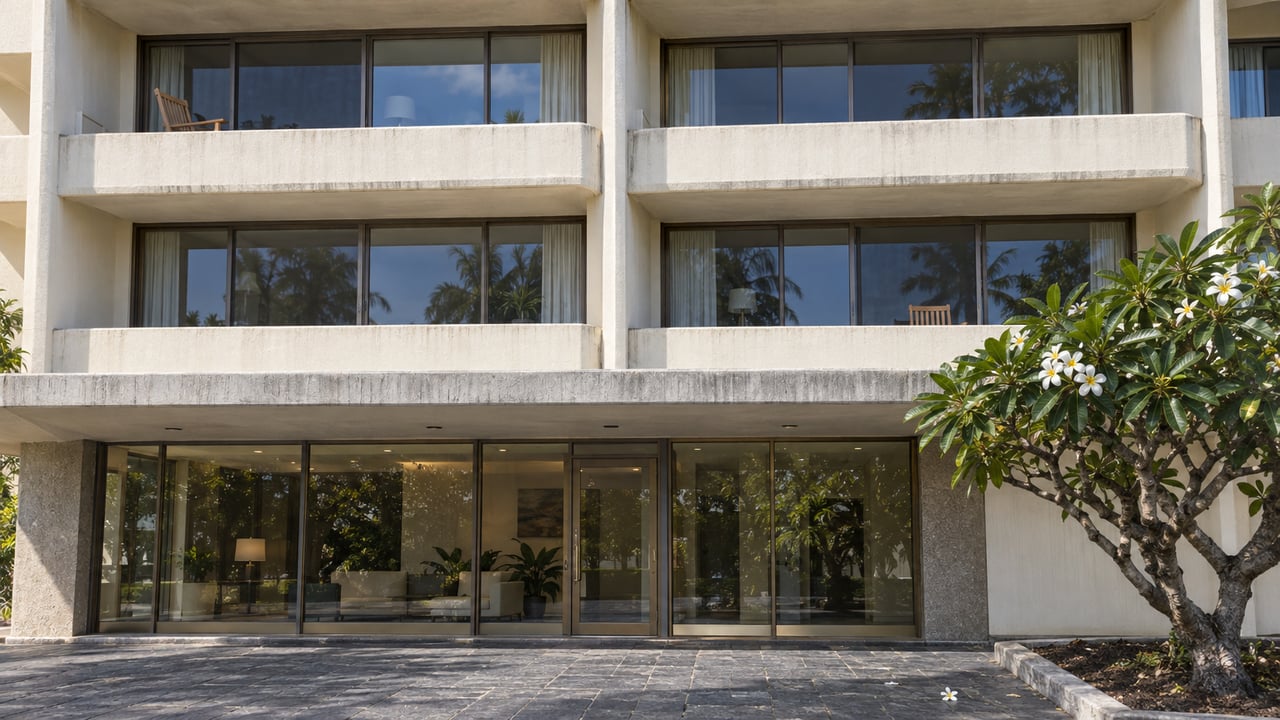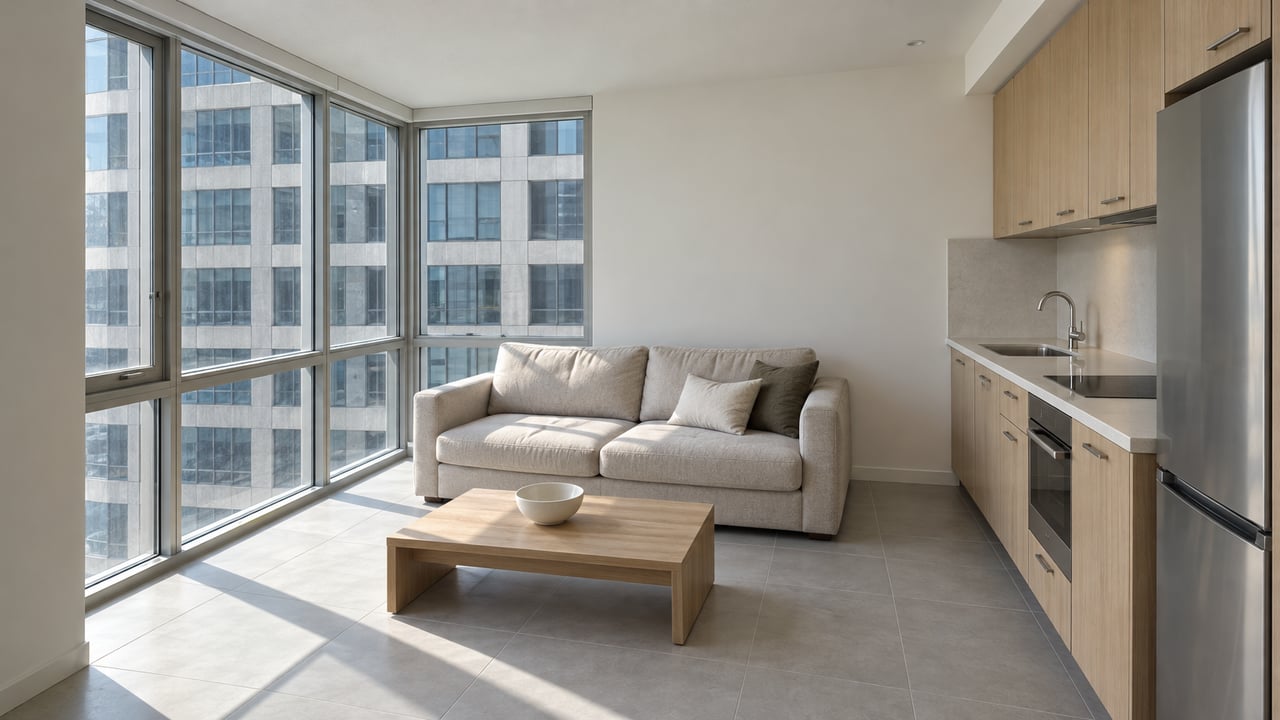
In June 2026, the Hawaiʻi Community Development Authority published a resale notice for Ulana Ward Village at 828 Auahi Street. It listed unit #409, a 289-square-foot studio, at $276,400. The next column on the same line read $238,600, labeled "Unit Shared Equity Amount."
That second number explains how Kakaʻako's reserved-housing condos work. The discount off market value is real at closing, but it stays attached to the unit as a claim HCDA collects later. Every other rule in the program, from the buyback option to the regulated-term clock, decides when and how that claim is paid.
Four Studios, Two Columns Each
HCDA's June 2026 Ulana announcement offered four studios that had come back through the buyback program. The last column below is simple addition of the two published figures.
| Unit | Size | Sales price | Shared equity | Sum of the two |
|---|---|---|---|---|
| #409 | 289 sq ft | $276,400 | $238,600 | $515,000 |
| #1603 | 289 sq ft | $332,300 | $202,700 | $535,000 |
| #3009 | 289 sq ft | $338,600 | $161,400 | $500,000 |
| #3503 | 289 sq ft | $345,100 | $239,900 | $585,000 |
All four sums fall between $500,000 and $585,000. For August 2026, the Honolulu Board of REALTORS® reported an Oʻahu condo median of $510,000, down 1.0% from $515,000 in August 2025. So these studios carry total values close to the island's typical condo, and the buyer pays a bit over half of that up front.
These figures are a snapshot. The notice says sales prices will be reset to the calculated buyback price once a unit is approved for sale, and the shared-equity amount is adjusted to an appraisal when the unit becomes available.
What the Shared Equity Figure Does After Closing
HCDA's reserved housing FAQ explains the math for projects governed by the 2005 and 2011 rules, which include Ulana. The amount owed is the higher of two formulas:
- the original fair market value minus the original sales price, a fixed dollar figure written into the unit's Unilateral Declaration
- that same discount as a share of original value, multiplied by resale value minus original price minus sales costs
HCDA says the fixed figure "generally yields the higher number."
Run the #409 numbers through it. If that studio later sold at $515,000, the first $238,600 above the owner's purchase price would go to HCDA. That leaves the $276,400 purchase price, minus sales costs and whatever is still owed on the mortgage. Under the fixed formula the owner keeps appreciation above the original value. With the island median down slightly year over year as of August 2026, that appreciation is the only part of the gap the owner actually earns.
The claim also outlasts the regulated term. HCDA states plainly that "the Shared Equity payment requirement never expires" and comes due at sale or any transfer of title, whenever that happens. When the term ends, the owner can list at market without HCDA approval, but still has to pay the shared equity and get a signed release before closing.
Selling Early Means Selling at HCDA's Price
During the regulated term, HCDA holds the first option to buy the unit back. Per the FAQ, the buyback price "will be determined by a specific formula by rule and is not negotiable." For Ulana, that formula is in HAR §15-22-186 of the Mauka Area Rules. Those rules have been repealed, but they still apply to the project as they stood when it was approved.
At Ulana, this question came up very soon after closing. Howard Hughes reported that construction finished and buyer closings began in November 2025. By December 31, 2025, 690 of 696 units had closed. HCDA's February 2026 Kakaʻako report recorded three January requests to sell during the regulated term, two at Ulana and one at ʻAʻaliʻi. A separate Ulana buyback was already in escrow with the Hawaii HomeOwnership Center.
HCDA saw this coming. When the board adopted the Ulana buyback plan in July 2025, staff told members that higher interest rates since buyers signed contracts in 2021 "will likely cause financial strain," according to the meeting minutes. HHFDC offered to lend HCDA up to $3 million from its Dwelling Unit Revolving Fund over the first two years to help pay for buybacks.
The plan now gives HCDA five ways to handle an Ulana unit offered for buyback:
- HCDA or a designated entity, currently only the Hawaii HomeOwnership Center, buys the unit and resells it as affordable housing. If the Center buys it, the unit joins the Center's own program and HCDA collects no shared equity.
- HCDA requires the owner to sell at the buyback price to a qualified buyer that HCDA's broker finds from a waitlist.
- HCDA buys the unit and rents it as affordable housing for the rest of the original term.
- HCDA waives the buyback and collects the shared equity right away, which lets the owner rent or sell at market.
- The owner's own broker finds a qualified buyer, at the same buyback price and with HCDA giving final approval of the buyer.
The board approved Option 5 on May 6, 2026, by a 7–0 vote with two members excused. The staff report gave the reason: some owners needed relief faster than the state procurement process could deliver it. Option 5 shortens the timeline but leaves the price unchanged, and HCDA picks the option for each unit case by case.
The Next Buyer Starts a New Clock
A buyer of one of these units does not step into the remaining years of the seller's term. Under Option 5, HCDA issues a new Unilateral Declaration that "would reinstate the regulated term and shared equity requirements for the new buyer." In July 2025, HCDA staff told the board that a term resets when a new declaration is signed, and its length can change if the unit price is adjusted.
At Ulana, term length depends on how affordable the unit is. Units priced for incomes below 100% of area median carry ten years, 100% to 119% carry five, and 120% to 140% carry two. HCDA's May 2026 staff report counts 52 units with two-year terms, 501 with five-year terms and 144 with ten-year terms. Terms start on the date the deed is recorded. Exact end dates depend on when each deed was recorded. Because closings began in November 2025, the earliest two-year terms would run until roughly late 2027, and the five-year terms, which cover most of the building, until around 2030.
The 2026 eligibility limits for an Ulana purchase:
- Income, at 140% of median: $130,700 for one person, $149,400 for two, $186,750 for four
- Assets, capped at 125% of the income limit: $163,375 for one person, $186,750 for two, $233,438 for four
- Ownership history: no majority interest in a principal residence during the prior three years
- Occupancy: the buyer must live in the unit throughout the regulated term
Applications must be delivered by hand, and HCDA keeps adding them to a waitlist until every unit's regulated term has expired.
Which Rulebook Applies Depends on the Building
The formulas above are not the same across Kakaʻako. On its reserved housing page, HCDA lists ʻAʻaliʻi and Ulana under the 2005 rules and 803 Waimanu under the 2011 rules. It also says no current projects fall under the 2018 rules. The 2018-style formula in HAR chapter 15-218 is different. It sets shared equity as a rounded percentage of resale value, owed only when that percentage is 0.5% or higher and the resale value is above the original price. Each unit's recorded deed and declaration are what actually govern it.
Some buildings mix several programs. At 803 Waimanu, 40 of the 153 units fall under HCDA reserved-housing rules, and the rest are split between HHFDC-restricted and market-rate units. HHFDC's July 2025 report said all of the HCDA-restricted units had sold by June 19, 2025.
HCDA's next model uses leasehold. Its August 26, 2026 update describes the Block P-3 99-year leasehold pilot as 377 units: 226 for buyers at or below 140% of median and 151 at market. The development agreement and ground lease were still being negotiated at that point. Act 121 of 2026 amended that program, including its owner-occupancy rules and how buyback prices are set. A decision-making hearing on the proposed rule amendments is scheduled for December 2, 2026.
Short Answers to Common Questions
Can an owner rent out the unit during the term? Not normally. Owners must live in the unit during the regulated term unless HCDA waives its buyback option.
Does adding a spouse to the title trigger anything? Yes. HCDA says any change in title, including additions after marriage and removals after divorce, triggers a release from the program and payment of shared equity.
Can the shared equity be paid off early? Yes. A rule amendment allows prepayment, and HCDA publishes the process on its prepayment page.
Is borrowing against the unit limited? Yes. Under HCDA's FAQ, a second mortgage is capped at the original contract price plus any partial shared-equity payments, minus the remaining first mortgage. Combined borrowing also cannot exceed the city's assessed value if that is lower than the original price.
This post is general information, not legal, tax or financial advice. Confirm how any reserved-housing rule applies to your unit with HCDA, a real estate attorney or your lender.
Thinking about a Kakaʻako reserved-housing unit, or deciding whether to sell one during or after its regulated term? Fortune Hawaii Realty can go through the unit's declaration, its rule vintage and the buyback math with you in English or Mandarin before you commit. Book an Appointment.