A house in Diamond Head's core area can sell for eight figures and still run into the same twenty-five-foot ceiling as the bungalow next door, as Honolulu Magazine reports. That's the part buyers rarely price in before they close: the constraint on what you can build here has nothing to do with lot size, architect fees, or the number on the wire. It comes from an ordinance the City and County of Honolulu passed in 1999, and it applies the same way to a modest fixer and a design-team showcase.
Most people encounter Diamond Head's special district status the way they encounter any zoning detail: as a line item they skim past during due diligence, right up until it changes what a renovation or a rebuild can actually look like. Understanding it before you write an offer, not after, is the difference between a straightforward permit and a redesign six months into the process.
The Ordinance Behind the Skyline
Diamond Head's special district status is written into Honolulu's Revised Ordinances at Section 21-9.40. The code states plainly that Diamond Head's natural appearance and prominent public views carry local, state, national, and international significance, and that protecting the views of the monument is a matter of established public policy. That language became law under Ordinance 99-12, which means the district has now governed construction here for more than a quarter century.
The core area sits between two streets: Diamond Head Road and Monsarrat Avenue. Inside that boundary, building heights cap at 25 feet. That number is not arbitrary. Oahu has seven special design districts in total, and each one sets its own limits based on what it's trying to protect. As Honolulu Magazine reports, Waikiki's district allows towers up to 350 feet on the Ala Moana end. Chinatown allows 40 feet along the street and up to 230 feet set back from it. Diamond Head's 25-foot cap is among the tightest of the seven, and it exists for one reason: to keep the crater itself, roughly 800 feet at its highest point, from ever being crowded or obscured by what gets built at its base.
For a buyer comparing Diamond Head to almost any other premium Oahu address, this is the detail that doesn't show up in a listing photo. A large lot here doesn't buy the same vertical flexibility a similarly priced lot might carry in Kahala or Kakaako. It buys square footage you have to find by going wide, or down a slope, rather than up.
Other Design Guidelines to Review
The height cap gets the attention, but other guidelines are worth reviewing before a project begins.
What the Rule Actually Does to a Real Project
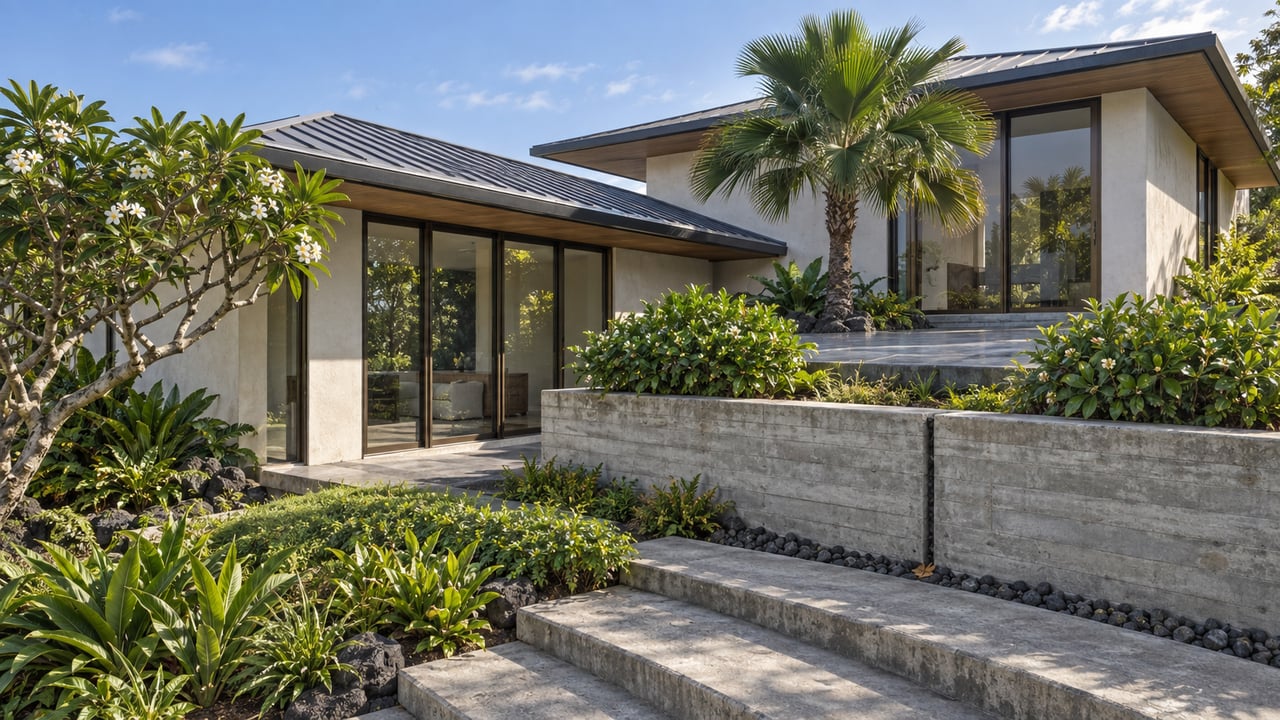
As Hawaii Home + Remodeling reported, a clear example of how the district’s height restrictions apply regardless of budget comes from a recently completed home called Hale Leahi, designed by ADM Architecture + Interiors and recognized with the 2024 AIA Honolulu Editor's Choice Award. This wasn't a modest remodel. The homeowners wanted high ceilings, natural light and ventilation, ample square footage, and unobstructed views of Honolulu, the kind of program that in almost any other neighborhood would resolve itself by building up.
Instead, the design team, led by principal Grant Sumile, had to work within a 15-foot maximum building height above the main finished floor elevation. To give the homeowners the 13-foot ceilings they wanted inside that envelope, ADM tiered the house down the slope of the crater, with a two-story, street-level presentation set back twice the district's required minimum. Sumile has described the ceiling height and the massing constraint as adding a real layer of complexity to the design process. The house exists, and it won a regional design award, but it exists because a talented team spent real design hours solving a problem that money alone couldn't remove.
That's the pattern worth sitting with. The Hale Leahi clients weren't working with a limited budget or an inexperienced architect. They faced the district's height restrictions, and the solution was design ingenuity, not a bigger check.
Reading a Diamond Head Listing With This in Mind
It's common to see Diamond Head properties marketed with language like "sold as-is, ready for renovation" or "bring your contractor," and for buyers evaluating these listings, the height and setback rules are the first filter that should apply, before floor plans, before finishes, before anything else. A property described as a renovation opportunity in Diamond Head's core area is a renovation opportunity within a 25-foot envelope. That reframes what "potential" actually means on that lot.
For a buyer looking at a teardown or a heavy remodel, the practical steps are straightforward, even if they're easy to skip in the excitement of a good location:
- Confirm whether the parcel falls inside the core boundary (Diamond Head Road to Monsarrat Avenue) or the larger special district footprint, since the two carry different levels of scrutiny.
- Talk to Honolulu's Department of Planning and Permitting early, before a design gets finalized, not after.
- Budget design time, not just design fees, for a team that has solved this specific constraint before. Hale Leahi is proof it can be done well, but it took a specific kind of architectural problem-solving to get there.
None of this makes Diamond Head a harder place to own. It makes it a place where the rules are baked into the land itself, in a way that a buyer moving from a neighborhood without a special district overlay might not expect.
Why the District Exists at All
It helps to remember what the ordinance is actually protecting. Diamond Head, or Lēʻahi, has been a state and national monument for decades, and the same 1999 ordinance that caps building height frames the crater's views as a resource that belongs to more than the people who own property near it. The underground utility lines, the sidewalks on both sides of the street, the mature trees along the main roads, all of it reflects the same underlying goal: keep the neighborhood readable as a monument setting, not just a collection of individually impressive lots.
That's a different kind of value proposition than most luxury real estate offers. You're not just buying a view of Diamond Head. You're buying into a legal framework that keeps that view available to your neighbors and, eventually, to whoever buys your house after you.
A Few Direct Questions
Does the 25-foot limit apply to the whole Diamond Head area, or just a smaller section? The tightest restriction applies to the core area between Diamond Head Road and Monsarrat Avenue. The broader special district extends further, and the applicable rules can vary depending on exactly where a parcel sits, which is why confirming the boundary early matters more than assuming based on a mailing address.
Can a homeowner apply for a variance to exceed the height limit? Given the ordinance's stated purpose of preserving public views of the monument, approval isn't something to assume going in. Anyone planning a build that pushes against the limit should have that conversation with the department before finalizing architectural plans, not after.
What about a home that was built taller before the ordinance existed? Older homes that predate the 1999 ordinance and exceed today's limits are another reason a pre-purchase conversation with a designer familiar with the district matters more here than in a neighborhood without an overlay.
If you're weighing a Diamond Head purchase with renovation or rebuild plans already in mind, it's worth having that conversation before you write the offer, not after. Fortune Hawaii Realty works through exactly this kind of zoning-aware due diligence with buyers and sellers across Honolulu's special districts, and a short conversation upfront can save months of redesign later.
This article is general information, not legal, tax or financial advice. Consult a qualified professional about your situation.