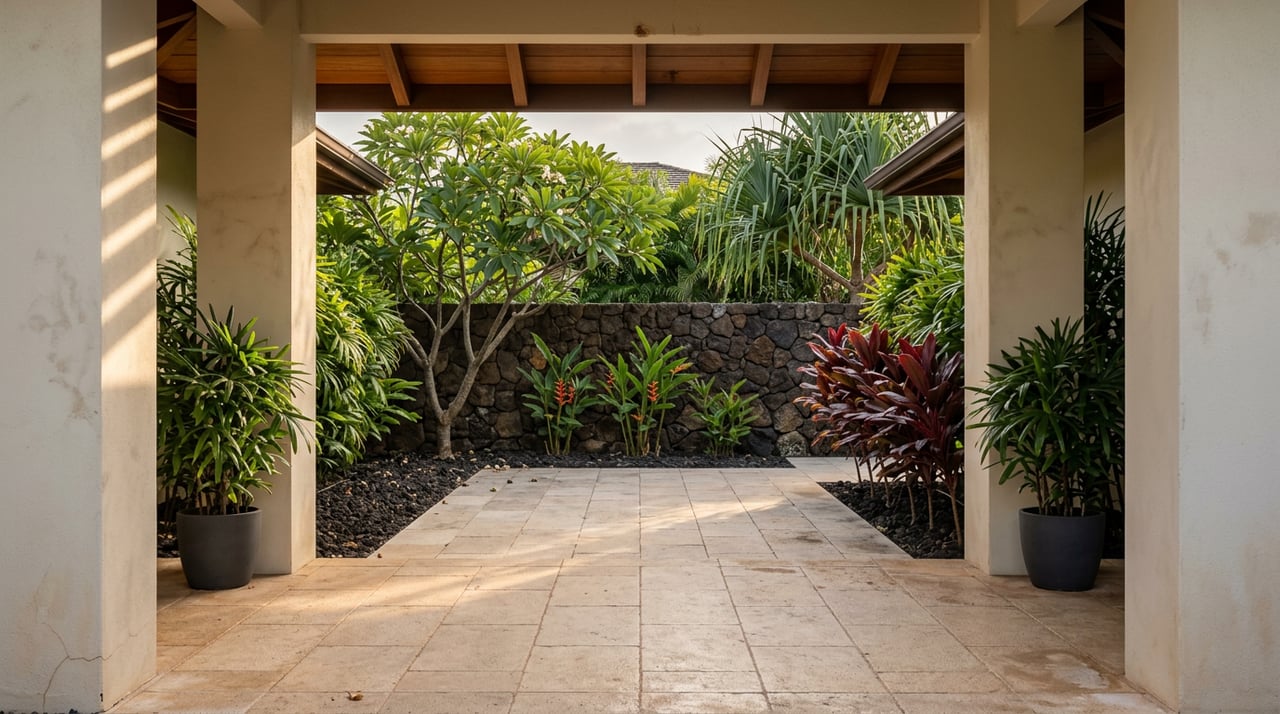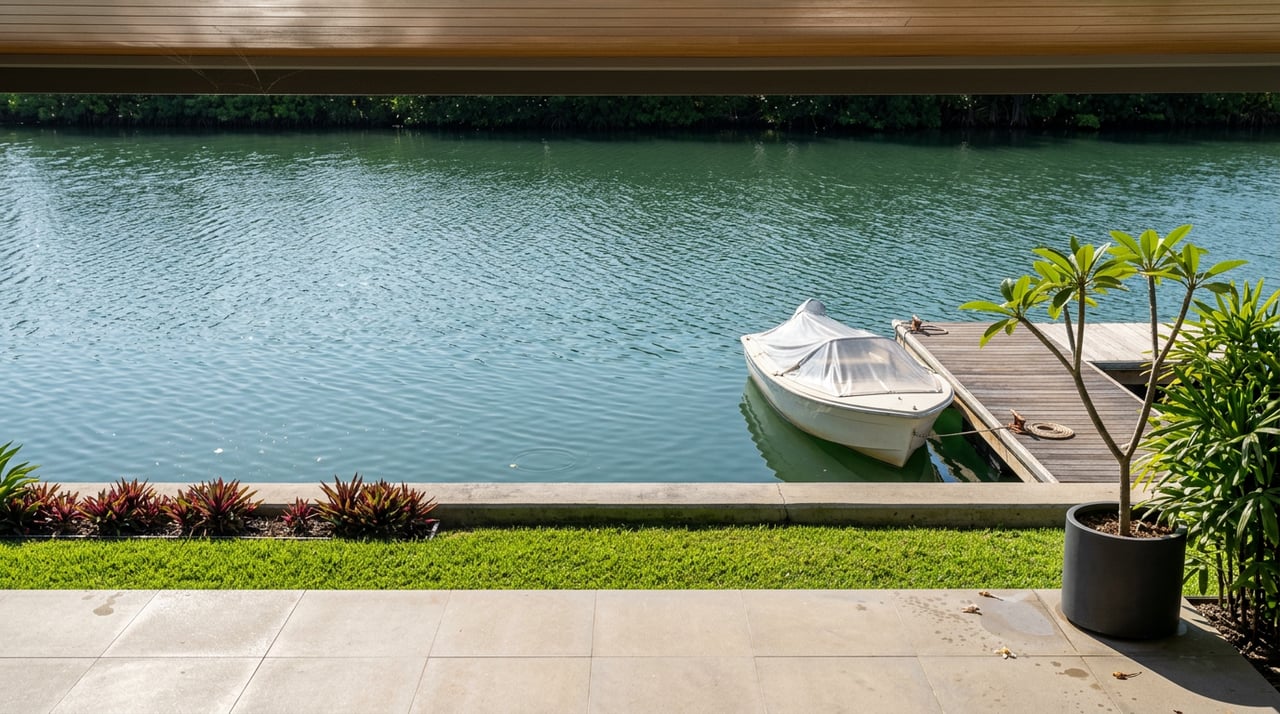
Most of ʻĀina Haina looks quiet from Kalanianaole Highway. Ranch-style houses, tucked driveways, a fire station, a stretch of grass along the water. The neighborhood reads like a place that would spread its daily errands across a dozen small stops.
It does not. Life here collapses into three anchors that residents cycle through on repeat. One is a shopping center. One is a trailhead. One is a beach park that almost nobody swims at. Once you see the pattern, the neighborhood makes more sense.
Anchor One: The Shopping Center Is Basically the Living Room
The Aina Haina Shopping Center sits at the intersection of Kalanianaole Highway and West Hind Drive, and it does the work of a town square for east Oʻahu. Foodland Farms anchors the block, and around it sit the businesses residents actually rotate through: La Tour, Starbucks, Uncle Clay's shave ice, Pieology, Subway, Crumbl Cookies and McDonald's, plus Longs Drugs, a bank, the post office, and the public library.
The gravitational center of the food side of the property is Jack's Restaurant. Jack's was originally opened in 1964 by Jack Hee in Aina Haina Shopping Center, and it remains in the same spot, serving popular items like the griddle cake omelet, corned beef hash and its famous biscuits with whipped honey butter. The current owners, Norman and Michelle, came into the business by an unusual route. Norman briefly worked at Jack's as waitstaff in 1992 before accepting a management job at a hotel restaurant in Waikiki, Michelle took over his position, and a decade later, they jumped at the chance to buy Jack's. The biscuit prep is not a metaphor. "At 5 o'clock, we come to make the biscuits," says Norman. "So we got everything pre-measured the day before."
Two other tenants are worth naming for the residents who forget how long they have been here. Mama Pho was first established in 2011 at Aina Haina Shopping Center, with our grand opening taking place on October 15, 2011. That is a fifteen-year run at the same address, in a Vietnamese category where five years is a milestone. La Tour Cafe and Pieology round out the sit-down and grab-and-go rotation, and Foodland Farms hosts a Maʻo Farms produce partnership that quietly shifts what "local" means on the shelves.
If you are trying to place a friend inside the neighborhood on a Saturday morning, you will find them within four hundred feet of the Foodland Farms entrance. The rest of ʻĀina Haina is bedrooms and driveways.
Anchor Two: The Trailhead at the End of Kalaʻau Place
The second anchor is a specific driveway-lined dead-end street. Kuliʻouʻou Ridge Trail sits between ʻĀina Haina and Hawaiʻi Kai and is one of a handful of state-managed trails that end at a summit atop the Koʻolau Mountains, and of the three that traverse this stretch of the range, this five-mile hike is slightly longer and a tad more difficult than Wiliwilinui Ridge but easier than Hawaiʻi Loa Ridge, and it is also easily the most popular, with its gradual switchbacks and shady paths.
For residents, the interesting part is not the summit. It is the parking. By just after noon on a Friday, the entire stretch of road can already be lined with cars, and hikers park on Kuliʻouʻou Road and walk up the steep street to the trailhead. If your morning routine involves the top of Kalaʻau Place, plan around it. The lot fills first, the street fills next, and the walk-up buffer is the tell.
The final section of the trail has a specific piece of infrastructure worth knowing. As on both Wiliwilinui and Hawaiʻi Loa ridge trails, the final ascent is marked with stairs, these steps are maintained by the state's Nā Ala Hele program and the Sierra Club of Hawaiʻi to slow erosion and make it safer and easier for hikers to climb to the summit, and there are just about 300 steps on this trail to the top, which really isn't too bad.
The trail also runs harder than it looks on paper. On March 9, 2025, the Honolulu Fire Department responded to a hiker on the Kuliʻouʻou Trail in ʻĀina Haina with 6 units staffed by 17 personnel. Additional units secured a landing zone at Kuliʻouʻou District Park in preparation for air operations, a male in his 50s had been hiking for approximately 50 minutes when he suffered an injury and was unable to descend the trail on his own, HFD personnel arrived at the hiker's location at 1:19 p.m., and the hiker was then safely airlifted to the landing zone. Seventeen personnel and a helicopter landing zone at the district park is a useful mental image the next time somebody describes the hike as easy.
Residents with a car and a morning have two other options that start on the ʻĀina Haina side of the ridge:
- Wiliwilinui Ridge Trail, roughly five miles round-trip, whose panorama from the top of the ridge sits at an elevation just shy of 1,600 feet, with views of Waikiki, Honolulu, Waimanalo and Konahuanui, the highest peak in the Koʻolau Mountain range. The trail starts off nice and easy with a paved road, which gives way to a wide dirt road for just over a mile; the well-maintained trail was built by the U.S. Army in 1941 and was originally used as a service road.
- Kuliʻouʻou Valley Trail, the flat sibling of the ridge hike. Kuliʻouʻou Valley Trail is a very short and shady two-mile walk along a well-groomed and graded path through this leeward valley, perfect for beginners or families.
- The valley trail at the end of Hao Street, which most guidebooks skip. As a tourist, you could visit Oʻahu every year and never know neighborhood hikes like this trail in ʻĀina Haina existed, and the hike starting from the back of the ʻĀina Haina neighborhood, where Hao Street dead ends, is one that spreads by word of mouth.
Anchor Three: Wailupe Beach Park Is Not the Beach You Think It Is
The third anchor is the strip of grass along Kalanianaole between the shopping center and the peninsula. Newcomers read it as a beach. Residents read it as something else entirely.
Wailupe Beach Park is a small neighborhood park in east Honolulu, located in ʻĀina Haina; the beach is very narrow and the water looks brown and murky, it is not a good beach for swimming because the nearshore ocean bottom is too shallow and there is a coral reef, and the beach park is mainly frequented by fishermen and local residents who come here for a picnic; it is easily accessible since it is located along Kalanianaole Highway.
The park's real function is as a launch point. Some surfers enter the ocean here to get to the surf spots Wailupe, Kimʻs, Suicides and Bones offshore, and even though it is a small park and water activities except for fishing, surfing and kayaking are not really possible, restrooms, showers and picnic tables are available. If you see people carrying boards across the grass, they are not confused. They are using the park the way it is meant to be used.
The peninsula next door has a history most people miss. The adjacent Wailupe Peninsula is man-made, in the early 20th century a fishpond was located here, and in the 1930s the company Hawaiian Dredging filled it up with coral and rocks, which came from building the adjacent boat channel. The quiet cul-de-sacs on the peninsula sit on what used to be a Hawaiian loko iʻa. That is worth knowing before you form an opinion about the streetscape.
One more resident-grade detail. Surfrider Foundation volunteers sample the water at Wailupe on a regular schedule, and the Swim Guide public dataset shows the results. The Hawaiʻi Department of Health protocol labels all Enterococcus samples over 130 MPN/100ml red as a health hazard, samples testing 36 to 130 MPN/100ml have medium bacteria levels and are labeled orange, and samples testing under 36 MPN/100ml have low bacteria and are labeled green. If you walk your dog past the park after heavy rain, that is the framework the state is actually using.
The Fall Calendar Worth Keeping in Your Phone
The neighborhood's dining orbit extends past the shopping center in one direction: toward the Kahala side. That matters more this year than usual. The 2026 Hale ʻAina Awards drew more than 6,000 ballots, and the top restaurants were announced during a live reception held June 9, 2026 at The Kāhala Hotel & Resort. The Kahala hotel sits within a fifteen-minute drive of ʻĀina Haina and is the anchor for the closest concentration of Hale ʻAina-recognized restaurants, including Plumeria Beach House and Arancino at the Kahala.
For a resident, that translates into a practical calendar habit:
- Weekday breakfast: Jack's for the biscuit, La Tour for the pastry case, Starbucks for the drive-through.
- Weekday dinner rotation: Mama Pho, Pieology, Foodland Farms hot bar.
- Weekend Kahala-side splurge: Plumeria Beach House at the Kahala Hotel, Arancino at the Kahala, or Kapa Hale on the Niu Valley end.
- Trail mornings: Kuliʻouʻou Ridge before 8 a.m., or Kuliʻouʻou Valley if you have the kids.
- Sunset walk: Wailupe Beach Park with a coffee, watching the fishing lines.
The three anchors are why ʻĀina Haina feels smaller than a neighborhood of nearly five thousand residents should feel. Everybody rotates through the same shopping center, the same trailhead, and the same beach park. Once you notice the pattern, you stop trying to find the fourth one. There is not one.
If you are thinking about your next move inside east Honolulu, or you own a property here and want a broker who reads the neighborhood at this level of detail, Fortune Hawaii Realty works this corridor with development-grade marketing and bilingual client service. Book an Appointment when you are ready to talk.